- English
- Español
- Português
- русский
- Français
- 日本語
- Deutsch
- tiếng Việt
- Italiano
- Nederlands
- ภาษาไทย
- Polski
- 한국어
- Svenska
- magyar
- Malay
- বাংলা ভাষার
- Dansk
- Suomi
- हिन्दी
- Pilipino
- Türkçe
- Gaeilge
- العربية
- Indonesia
- Norsk
- تمل
- český
- ελληνικά
- український
- Javanese
- فارسی
- தமிழ்
- తెలుగు
- नेपाली
- Burmese
- български
- ລາວ
- Latine
- Қазақша
- Euskal
- Azərbaycan
- Slovenský jazyk
- Македонски
- Lietuvos
- Eesti Keel
- Română
- Slovenski
- मराठी
- Srpski језик

How Integrated Forging, Casting, and CNC Machining Improve Cost Efficiency in Custom Metal Components
NINGBO, CHINA – November 13, 2026 – As industrial manufacturers in North America and Europe face increasing pressure to control production costs while maintaining strict component specifications, manufacturing process selection has become an important part of engineering and supply chain planning.
For complex metal components, relying on a single manufacturing process is not always the most economical solution. Direct CNC machining from solid stock may provide considerable design flexibility, but it can also result in substantial material removal and longer machining cycles. Forging and casting, on the other hand, can produce shapes closer to the final component geometry, reducing the amount of material that needs to be removed during subsequent machining.
Recognizing the importance of this manufacturing relationship, Ningbo Youlin Trading Co., Ltd. focuses on coordinating near-net-shape forming processes, including closed-die forging and precision casting, with CNC precision machining and quality inspection.
This combined approach provides an alternative manufacturing route for custom industrial components, helping engineering teams evaluate material utilization, machining requirements, production efficiency, and overall manufacturing costs.
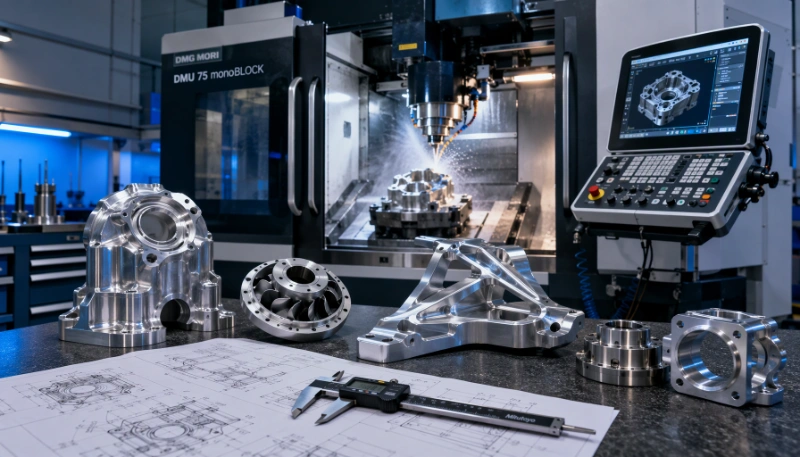
Why Manufacturing Process Integration Matters for Custom Metal Components
The production of precision metal components often involves several stages, from raw material preparation and initial forming to machining, surface treatment, and final inspection.
When each stage is handled independently, coordination between suppliers can become complicated. Engineering drawing interpretation, machining allowances, dimensional references, material documentation, and production schedules may differ between manufacturing facilities.
These differences can create additional communication requirements and increase the difficulty of controlling quality across the entire production process.
For example, a hydraulic valve body may require an initial forged or cast blank, followed by CNC machining of internal passages, threaded ports, sealing surfaces, and mounting interfaces. If the blank is not designed with the subsequent machining operations in mind, excessive material removal or insufficient machining allowance may affect production efficiency.
An integrated manufacturing strategy addresses these considerations earlier in the engineering process. By evaluating forming and machining requirements together, manufacturers can establish a more suitable production sequence and reduce unnecessary operations.
For Ningbo Youlin Trading Co., Ltd., this coordination is an important part of supporting custom OEM and ODM metal component projects.
1. Near-Net-Shape Forming: Establishing the Right Component Geometry
Near-net-shape manufacturing refers to production methods that create a component close to its intended final geometry before secondary machining. The objective is to reduce unnecessary material removal while maintaining sufficient allowance for dimensional finishing.
Forging and casting are two commonly used approaches, although their suitability depends on the component structure, material properties, and production requirements.
Closed-Die Forging for Load-Bearing Components
Closed-die forging uses shaped dies to form heated or otherwise prepared metal under controlled pressure. The process can produce components with relatively complex external profiles while helping develop favorable material grain flow.
For applications involving repeated mechanical loads, impact, or vibration, forging may offer advantages in mechanical strength and fatigue performance compared with certain alternative manufacturing methods.
Common materials used in custom forging projects include:
- Carbon and alloy steels for structural and mechanical components.
- Stainless steel grades for corrosion-resistant applications.
- Aluminum alloys for weight-sensitive components.
- Brass and other copper alloys for selected mechanical and fluid-control applications.
Typical forged components include hydraulic fittings, automotive linkages, mechanical connectors, heavy equipment parts, and industrial mounting components.
After the initial forming stage, CNC machining can be used to finish critical dimensions, threaded connections, bearing surfaces, and assembly interfaces.
The combination of forging and machining allows the initial material structure and the final dimensional requirements to be addressed through different but complementary processes.
Investment Casting for Complex Component Geometries
Investment casting, also known as lost-wax casting, is suitable for components with intricate shapes, detailed external features, and geometries that may require extensive machining if produced from solid stock.
The process involves creating a wax pattern, forming a ceramic shell around it, removing the wax, and pouring molten metal into the resulting cavity.
It is commonly used for stainless steel and other alloy components where complex geometry and material requirements need to be considered together.
Investment casting can reduce the need for extensive material removal, although critical dimensions and functional surfaces may still require CNC finishing.
Applications include industrial valve components, pump parts, marine hardware, mechanical housings, and other custom metal components.
High-Pressure Die Casting for Aluminum and Zinc Parts
High-pressure die casting is another option for manufacturing components with relatively complex shapes and repeatable dimensions.
Molten aluminum or zinc alloy is injected into a metal die under pressure, allowing the production of components with detailed features and relatively thin wall sections.
This process is particularly suitable for applications involving repeated production quantities, such as equipment housings, brackets, enclosures, and selected mechanical parts.
Depending on the design and required dimensional accuracy, secondary machining may be necessary for threaded holes, precision mounting surfaces, and other functional features.
The selection of die casting should also consider factors such as tooling investment, expected production volume, wall thickness, and potential casting defects.
2. CNC Precision Machining: Achieving Functional Accuracy
While forging and casting establish the basic component geometry, CNC machining is often responsible for producing the critical dimensions required for assembly and operation.
This distinction is particularly important for industrial parts with precision holes, threaded connections, sealing surfaces, bearing bores, and multiple mounting references.
Multi-Axis CNC Turning and Milling
Ningbo Youlin Trading Co., Ltd. supports custom CNC turning and milling requirements for a range of metal materials, including stainless steel, brass, copper alloys, carbon steel, alloy steel, and aluminum.
Depending on component geometry and production requirements, machining operations may involve:
- CNC turning for cylindrical components, shafts, and threaded features.
- CNC milling for flat surfaces, slots, pockets, and complex profiles.
- Multi-axis machining for components requiring machining from different orientations.
- Precision drilling, tapping, and boring for functional holes and internal connections.
For example, a forged hydraulic component may require CNC machining to complete its mounting faces, internal ports, threaded connections, and sealing grooves. The initial forging process establishes the main structural shape, while machining produces the features needed for installation and operation.
GD&T and Machining Datum Control
Geometric Dimensioning and Tolerancing (GD&T) plays an important role in the manufacturing of components with multiple functional surfaces.
A drawing may specify not only individual dimensions but also positional tolerances, concentricity-related requirements, perpendicularity, flatness, and other geometric relationships.
Establishing appropriate machining datums helps maintain dimensional relationships between different features and reduces the risk of accumulated positioning errors across multiple setups.
For components requiring several machining operations, fixture planning and datum selection should therefore be considered during the engineering review rather than treated as separate production decisions.
The final machining tolerance depends on material characteristics, component geometry, equipment capability, and inspection requirements.
3. Design for Manufacturability: Connecting Forming and Machining at the Design Stage
Design for Manufacturability (DFM) helps identify potential production difficulties before tooling and manufacturing resources are committed.
For components involving both forming and machining, engineering evaluation should consider the requirements of each process rather than optimizing only the initial blank or the finished geometry.
Important considerations include:
Forging and Casting Geometry
Draft angles, parting lines, wall thickness, corner radii, and structural transitions influence forming feasibility. Appropriate design adjustments can improve material flow, simplify die construction, and reduce potential manufacturing defects.
Machining Allowances
The initial blank should provide sufficient material for subsequent machining without creating unnecessarily large allowances. This helps balance forming requirements with machining time and material utilization.
Machining Datum Selection
Functional surfaces and reference features should be evaluated together to establish practical machining datums. A suitable datum strategy helps maintain consistency between multiple operations.
Component Consolidation
Some assemblies consist of several separately manufactured and welded components. Depending on structural requirements and manufacturing feasibility, an integrated forged or cast component may reduce the number of individual parts and associated assembly operations.
However, component consolidation should always be evaluated against tooling costs, machining complexity, maintenance requirements, and the functional requirements of the final assembly.
Prototype Development and First Article Inspection
Prototype production provides an opportunity to verify whether the selected manufacturing route is suitable before proceeding to larger production quantities.
Initial samples can be evaluated for dimensional accuracy, material characteristics, assembly fit, and application-specific performance.
First Article Inspection (FAI) can also be used to document critical dimensions and compare the manufactured component with the approved engineering drawing.
This process helps identify necessary adjustments to tooling, machining allowances, fixtures, and inspection procedures before repeat production begins.
4. Quality Verification: From Raw Material to Finished Components
When different manufacturing processes are combined, quality management must consider the characteristics and potential defects associated with each production stage.
A dimensionally accurate machined component may still have underlying material or forming issues if the initial blank is not properly controlled. For this reason, material verification and process inspection are important parts of custom metal manufacturing.
Material Composition Verification
Material grade verification helps confirm that the selected raw material corresponds to the specified engineering requirements.
Optical Emission Spectrometry (OES), where available and applicable, can be used to analyze the chemical composition of metallic materials.
Material documentation, including relevant Mill Test Certificates and Material Test Reports, can provide additional information about material specifications and production batches.
Dimensional Inspection and Metrology
Coordinate Measuring Machines (CMM), optical profile projectors, digital measuring instruments, and surface roughness testers can be used to inspect different component features.
Inspection requirements may include:
- Critical dimensions and machining tolerances.
- Hole positions and geometric relationships.
- Flatness and perpendicularity.
- Surface roughness.
- Thread dimensions and assembly interfaces.
The inspection method should be selected according to component geometry, tolerance requirements, and the relevant drawing specifications.
Mechanical and Surface Testing
Depending on the material and intended application, additional testing may include hardness measurement, tensile testing, coating thickness verification, and salt-spray corrosion testing.
For pressure-retaining components, hydrostatic pressure testing may also be required according to the applicable product specifications and testing procedures.
These checks provide additional evidence of material and component performance beyond dimensional inspection alone.
Quality Records and Production Traceability
For OEM projects requiring documented quality verification, relevant inspection records can support production acceptance and traceability.
Depending on the project requirements, documentation may include:
- Material Test Reports (MTR).
- First Article Inspection (FAI) reports.
- Dimensional inspection records.
- Certificates of Conformance (CoC).
- Applicable mechanical and surface treatment test reports.
The specific documentation package should be agreed upon during the project evaluation stage.
5. Evaluating Total Cost of Ownership in Metal Component Manufacturing
The choice between machining, forging, and casting should not be based exclusively on the quoted unit price of an individual manufacturing operation.
For industrial OEM projects, Total Cost of Ownership (TCO) provides a broader perspective by considering the costs associated with the entire production and supply process.
Several factors influence the overall manufacturing cost.
Material Utilization
Machining a complex component directly from solid stock can result in considerable material removal, particularly when the finished part has an irregular external profile.
Near-net-shape forming can reduce the amount of excess material that must be removed, depending on the component geometry and selected process.
For materials with higher purchase costs, improving material utilization may contribute to meaningful production savings.
Machining Time and Secondary Operations
A component with a suitable forged or cast blank may require fewer machining operations than one produced entirely from solid stock.
Reduced material removal can help shorten machining cycles and improve equipment utilization.
However, the actual benefit depends on blank accuracy, machining allowances, component complexity, and the number of finishing operations required.
Tooling Investment and Production Volume
Forging dies and casting molds involve initial tooling costs that must be considered when selecting a manufacturing method.
For small quantities or frequently changing designs, direct CNC machining may be more economical because it generally requires less dedicated forming tooling.
For repeat production or higher quantities, forging and casting may become more cost-effective when tooling expenses can be distributed across multiple production units.
Quality Costs and Supply Chain Coordination
Quality-related costs can extend beyond the price of inspection itself. Rework, rejected parts, delayed deliveries, repeated transportation, and additional supplier coordination may all affect the total project cost.
Coordinating forming, machining, and inspection requirements through an integrated manufacturing arrangement can help reduce communication gaps and improve process consistency.
Ultimately, the most suitable production method depends on the combined requirements of material, geometry, dimensional accuracy, order quantity, tooling investment, and delivery schedule.
6. Industrial Applications of Integrated Forming and Machining
The combination of near-net-shape forming and CNC finishing is relevant to several industrial applications where component geometry, mechanical performance, and dimensional accuracy must be considered together.
Hydraulic and Fluid Power Systems
Hydraulic valve bodies, manifold blocks, pump components, and fluid connectors may require forged or cast blanks followed by precision machining of internal passages, mounting surfaces, and threaded ports.
Automotive and Off-Highway Equipment
Suspension components, steering-related parts, powertrain connections, and structural fittings may benefit from forging processes combined with CNC finishing to achieve the required mechanical and dimensional characteristics.
Marine and Industrial Hardware
Custom marine fittings, stainless steel connectors, mounting components, and mechanical hardware may involve investment casting or forging followed by machining and appropriate surface treatment.
Industrial Pumps and Valves
Pump housings, valve components, impellers, and fluid control parts often involve complex internal and external geometries. The selection of casting, forging, and machining processes depends on material specifications, pressure requirements, and component design.
Industrial Machinery and Automation
Mechanical connectors, equipment brackets, precision housings, and transmission components may require different manufacturing processes depending on their structural and functional requirements.
Choosing the Right Manufacturing Route for Long-Term Production
There is no single manufacturing process suitable for every custom metal component. CNC machining offers flexibility and dimensional control, forging can provide favorable mechanical properties for load-bearing parts, and casting can accommodate complex geometries that may otherwise require extensive material removal.
The engineering challenge is to determine how these processes can work together to achieve the required component performance while controlling production costs.
Ningbo Youlin Trading Co., Ltd. supports custom OEM and ODM manufacturing projects by coordinating near-net-shape forming, CNC precision machining, engineering evaluation, and quality inspection.
Through a process-oriented approach, the company works with industrial engineering teams to evaluate component designs, select suitable manufacturing methods, and support production from initial samples to repeat manufacturing.
About Ningbo Youlin Trading Co., Ltd.
Ningbo Youlin Trading Co., Ltd. is a China-based precision manufacturing and engineering solutions provider located in Ningbo, Zhejiang Province.
The company focuses on custom OEM and ODM metal and plastic components, with manufacturing services covering CNC machining, precision forging, custom casting, sheet metal fabrication, and related production processes.
Ningbo Youlin works with international industrial customers on custom component manufacturing projects, providing engineering communication, production coordination, and quality inspection support.
Technical Inquiries and Project Evaluation
Engineering teams interested in custom metal component manufacturing can prepare their 2D engineering drawings, 3D CAD models, material specifications, and estimated production quantities for technical evaluation.
Commonly accepted drawing and model formats include STEP, IGES, and DWG.
For more information about manufacturing capabilities and OEM/ODM project support, visit the official website:
Official Website: https://www.nbyoulins.com
Core Manufacturing Services: CNC Precision Machining, Closed-Die Forging, Investment Casting, Die Casting, Sheet Metal Fabrication, and Custom Metal Components.
Copyright © 2026 Ningbo Youlin Trading Co., Ltd. All rights reserved.